
縁友往来Message from Soulmates
- 縁友往来
- Sixth Century Asuka—The Cultural Milieu that Produced Horyu-ji Temple
Sixth Century Asuka—The Cultural Milieu that Produced Horyu-ji Temple
「これは、近頃の人が自然を尊いものと考えておらんからね。おじいさんやおばあさんに、朝起きると太陽を拝み、空気があるんで生きていられる、ありがたいいうて拝まされたもんや。
今は、太陽はあたりまえ、空気もあたりまえと思っている。心から自然を尊ぶという人がありませんわな。このままやったら、私は一世紀か2世紀のうちに日本は砂漠になるんやないかと思います。」 西岡常一
"My grandfather and grandmother made me pray. Pray to the sun when you get up in the morning, they said. Say thank you for the air, which enables us to live.
"Today, people take the sun and the air for granted. There are no people who truly respect nature in their hearts. If it continues this way, Japan will likely become a desert in one or two centuries, I think."
—Master Carpenter, Nishioka Tsunekazu
Asuka, Nara. October 2025
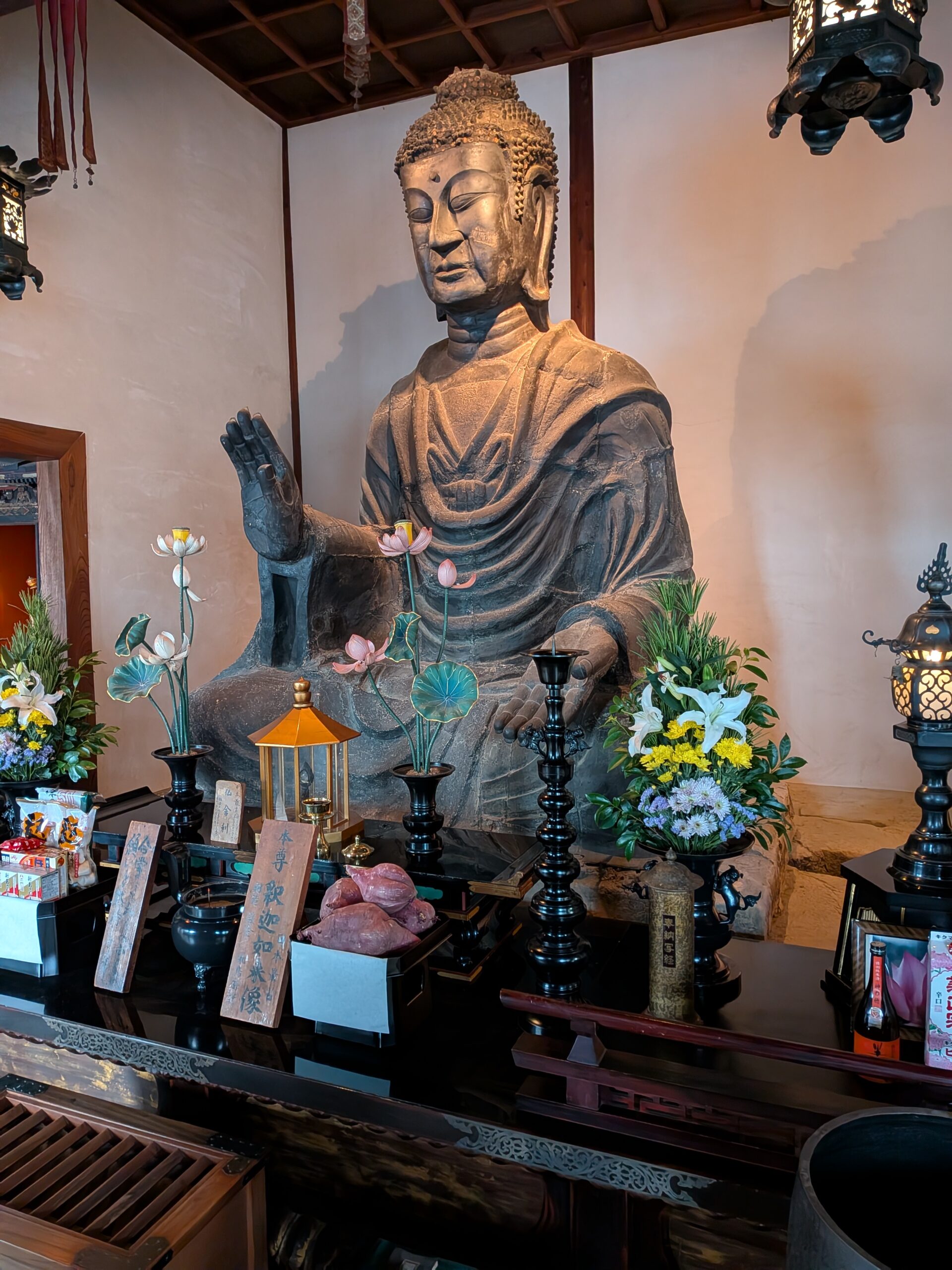
飛鳥寺での出会い。渡来人の孫、彫刻家のとり仏師の釈迦如来大仏。
On a day of crisp autumn air, the sun—the mystery of mysteries at the heart of nature’s eternal cycles—cast its brilliance on dry post-harvest rice fields under the lushly wooded hills of Asuka. Keiko and I stood in the small Main Hall of Asuka-dera temple, situated in the fields, gazing on its bronze Great Buddha statue created 1,400 years ago (606) by the grandson of a Korean immigrant.
ここは、聖徳太子の出産地と思われる橘寺や藤原京の遺跡、蘇我馬子の古墳と思われる「石舞台」など、数多くの古代遺跡まで歩いて行ける距離にある。
Here, we were within walking distance of Tachibana-dera temple (6th c.), said to be near Prince Shotoku’s birthplace, to the south and the ruins of the later Fujiwara-kyo imperial capital (694-710) to the north. We were only a short bus ride from two large circular tomb burial mounds (kofun)—the Ishibutai Kofun likely built for Soga no Umako (died 626) and the Takamatsuzuka Kofun (early 700 c.) whose chamber walls depict maidens in colorful Goguryeo-style Korean costumes.
この場に立てば、奈良で見たさまざまな史跡と寺社が他国との文化交流から生まれてきたことが感じられた。また、それが石部顯さんと流水さんの言葉を裏付けた。
Standing on this spot, I could feel how all we had seen in Nara—8th century temples such as Kofuku-ji and Toshodai-ji and the ruins of the Heijo-kyo imperial capital (710-784), arose from centuries of cultural exchange between the Japan archipelago and the mainland. It confirmed what Ishibe Akira and Ryusui had told me: Asuka in the late 5th century was a cosmopolitan capital hosting vibrant cultural exchange between Japanese and people from the Korean peninsula and China.
6世紀後半の飛鳥は、活気な文化交流を育ったコスモポリタンな首都。
Prince Shotoku, appointed regent in 593 by his aunt Empress Suiko (554–628), embraced Buddhism in his aim to establish a harmonious society. For this, he invited Buddhist scholars and skilled craftsmen from the mainland and established great temples. The new Buddhist beliefs commingled with many cultures in Asuka, all on a foundation of the “animism” of Japan’s paleolithic Jomon (13,000 BC - 350 BC) and Yayoi (350 BC - 250 AD) periods.
Centuries of migrations from the Korean peninsula had brought technologies such as rice cultivation, silk, and ironware, and in Prince Shotoku’s time, an age of large tomb mounds (300-538) dominated by rulers in Yamato Province (Nara) had just ended under the rise of the Soga clan. Chinese philosophical principles such as “qi” (vital force) and “hoi-gaku” (guardian powers of the four directions) were finding acceptance among Japan’s aristocrats through exchanges with China’s Sui (581-618) and Tang (618-907) dynasties.
飛鳥とは、日本の新時代を生んだインタグレーティブ・アカルチュレーション (文化変容)だった。
Japan’s indigenous culture absorbed these cultural and spiritual influences and fused them with its intimate understanding of nature. Asuka was a cultural fusion—an “integrative acculturation” out of which a new cultural age emerged in Japan.
法隆寺という、1300年経った今でも凜として美しい木造の寺。それを可能にした6世紀飛鳥の社会環境。
Something in this milieu enabled the creation of a wooden temple complex, unparalleled in excellence, that has stood for 1,300 years due to its carpenters’ wisdom and profound understanding of trees—Horyu-ji.
My theme as a gurojin (foolish old man) is to bring back the SUN, AIR, and RAIN to the foreground of my everyday awareness. The Asuka carpenters who built Horyu-ji 1,300 years ago had such an awareness of the world. They prayed to the sun and viewed trees as strong individual beings, rooted in place, each with its own personality and characteristics. When cutting a tree they prayed, vowing to sustain its life and characteristics in the temple building. The carpenters took on the responsibility to build a temple that could stand a thousand years.
Horyu-ji’s master carpenter, Nishioka Tsunekazu, speaks clearly of this—
「法隆寺はその頃文化の中心となる所やった。仏教を学ぶための尊い学問の場所や。それを建てるとう心構えが木を生かすことに表れたんですな。」
"At that time, Horyuji was intended to become a cultural center. A place of noble scholarship for the study of Buddhism. The mindset to build such a center found expression in the carpenters’ will to maintain the life of the tree in the assembly of the building."
2026/1/26
Comment
法隆寺の五重塔は、一つ一つ癖のある木を適切に組み合わせることによって、千年たっても倒れない強靭性を実証しています。聖徳太子の「和をもって貴しとなす」の精神を視覚化してくれています。
西岡常一氏の「法隆寺はその頃文化の中心となる所やった。仏教を学ぶための尊い学問の場所や。それを建てるという心構えが木を生かすことに表れたんですね。」の言葉に、その秘密が語られていると思いました。
飛鳥への旅のレポート、ありがとうございます。Brianと一緒にタイムトラベルしたような気持ちになりました。
愚老人(ぐろうじん)である私のテーマは、太陽、空気、そして雨を、日々の意識の最前線に呼び戻すことです。 1300年前、法隆寺を建立した飛鳥の大工たちは、まさにそのような世界観を持っていました。彼らは太陽に祈りを捧げ、木々を、それぞれの場所に根を張り、個性と特性を持つ力強い個体として捉えました。木を切る際には、その生命と特性を寺院建築の中で持続させようと誓い、祈りを捧げました。彼らは千年も続く寺院を建てるという責任を担っていたのです。
このBrianの言葉どうり、飛鳥の大工たちは、法隆寺が仏教を学ぶ崇高な学問の場となることを願っていたと思います。そして、心の深みから湧き上がったその意思のエネルギーがあったからこそ、法隆寺は1300年も続く世界最古の木造建築物になったのではないでしょうか。
たとえこの世で建物が朽ち果てることがあっても、法隆寺を創り上げた意思のエネルギーは、消えることなく霊界でも多くの魂に感動を与え続けると思います。
読みながら、50年前、聖徳太子が仏教を講義された法隆寺の講堂で、瞑想をさせていただいたときの静謐な時間と空間が心に甦ってきました。
“integrative acculturation”━異文化を新たに統合して、日本の文化に適用させる。それこそが、日本の「和」の精神を象徴する一つのキーワードだと思います。
感謝を込めて、西岡常一氏の言葉を、贈ります。
「大陸の雨の少ない建築」を吸収しながらも、「飛鳥の工人は日本の風土というものを本当に理解して新しい工法に変えたちゅうことです。基壇も高くなっています。……軒が浅くてはあかんぞと考えたんですな。徐々にやったんやなくて、そのとき一遍で直してるんです。こういうのを文化というのとちゃいますか」。
飛鳥の前には、弥生・古墳時代にも、多様な民族・文化が入っています。それらを洗練して統合する文化、━それこそが縄文時代に培われた智慧と精神であり━「和」の文化・こころの源流なのだと思います。
コメント投稿には会員登録が必要です。